white

White wines reviewed by the Wine Rambler:

Georg Mosbacher, Forster Elster, Riesling Kabinett trocken, 2007

When german Riesling is praised for its "finest perfume of fruit supported by a lightweight frame", it would seem that its ever-delicate balance must be so fragile that it would never survive contact with heavy, savoury food. Not so. To realise what Riesling can do with Sauerkraut, black pudding and liver sausage, you need to have tasted this classic german pairing* (do not, I repeat do not, take the Wine Rambler's word for anything).
For this, you need a Riesling that is dry rather than fruity, steely rather than floral, firm rather than ethereal. You need, in short, a dry Kabinett from the Pfalz. You also need good Sauerkraut and freshly made (raw, that is) sausages, of course. In what may simply be a local tradition or may have deeper and more sinister reasons of carnivore logistics, Munich butchers offer these every Friday.

Markus Molitor, Wehlener Klosterberg, Weißburgunder *** trocken, 2005

Uncertain what you are looking at here? Somehow strangely attracted yet also confused? Doubtful whether this actually belongs on a wine blog?

If this is what you feel looking at the above picture then welcome to my world of confusion and doubt about a wine of which I am not sure if it should exist at all. What do you do with a wine clocking in at 15% alcohol? How do you feel when you realise it is a white - and from one of the coolest wine regions of a cool wine growing country? Should Mosel winemakers really do this? Should any (white) wine be so strong? Is it actually drinkable? If you want a definitive answer to these questions, please do not read on.

A. Christmann, Weißburgunder "SC" Pfalz, 2008

The more Pinot Blanc I drink, the more I appreciate this grape variety. While you will find Pinot Blanc in France and, known as Pinot Bianco, in Italy, Germany is the country that grows more of it than any other: Weißburgunder, as it is known here. The Weißburgunder I am reporting about today was grown in the Pfalz, near the village of Gimmeldingen where the Christmann winery is based. The estate has been owned by the Christmann family for seven generations. It is headed by Steffen Christmann, who also happens to be head of the 'Prädikat Wine Estates', Germany's club of premier estates. In 2004, Christmann changed to organic production and recently even to biodynamic methods. I could not say whether this is the reason for a consistently high quality, but Christmann is certainly doing something right. Now let's have a look at this Pinot Blanc, shall we?

Dr. Heger, Oktav, Grauburgunder Kabinett, 2008

Imagine a hilly landscape somewhere in Europe. The sun is burning down. The temperature is way above 30° C. Sitting on a porch, you look around an area that was shaped by volcanic activity. While there is no lava any more, you have been told by locals that this small town is the warmest in the country. Your host returns to pour more Pinot Grigio. Southern Italy, you may think? Not at all! Chances are that you are sitting in the town of Ihringen in the South West of Germany, drinking a Pinot Grigio, Grauburgunder I wanted to say, made by the Heger winery. Well, it is still winter while I am writing this, but a few days ago I opened a bottle of a Grauburgunder, as the Pinot Grigio/Gris variety is called in Germany, for two friends here in London - Dr. Heger's Oktav.

Philipp Kuhn, Riesling Tradition, 2008

If you have ever come across the German village of Laumersheim, chances are it was because of a wine. Laumersheim is home to the Kinpser winery, a family owned estate that makes some of the best red wines you can get in Germany (and marvellous white wines too). And it is home to the Kuhn winery that is getting more and more attention, especially after Philipp Kuhn in 1992 - at the tender age of 20 - got involved in the family owned estate. You may be surprised to hear that the winery is not only producing some red wine, in fact about 50% of the wines made there are red. The delivery that brought this Riesling to London also included a Merlot! The story of red wine made by the Kuhns in the Palatinate will have to be told another night as tonight we are drinking the entry level Riesling from the Kuhn winery (entry level, by the way, does not mean mass-produced: harvests are limited to below 75 hl per hectare).

Ansgar Clüsserath, Trittenheimer Apotheke, Riesling Kabinett, 2008

Despite its pale lemon colour, this Riesling shines like gold (just in a light, quite pale lemon coloured way). It comes from the Mosel, from a vineyard near the village of Trittenheim, which is called 'Apotheke' - 'Pharmacy' in English (relating to the old-fashioned word Apothecary, of course). While I do normally not go so far as to recommend a wine as medicine, with this one I almost might - it is just such a refreshing joy to drink it.

The nose with its mineral and herbs makes me think of, well, the steep vineyards of the Mosel; add to that refreshing green apples, peach and half-fermented fruit and then finely dust the aromas with icing sugar. A bouquet that says: 'drink me, drink me now!'

torsten Wednesday, 13/01/2010

Ökonomierat Rebholz, Pi No "R", brut, 2005

Nine days into the new year and we're already sticking our noses into the sparkling wine again. Is that hedonistic cheek on our part or a commendable discipline in making good our new year's resolution number 2? Actually, it's neither, since this is a postscript to our new year's eve.

Lively, but not over-strong bubbles, a smell of ripe apples and quince. Bone dry and almost austere at first taste, but at the same time fairly creamy and intense, with the tiniest hint of oak maybe, and in the end, it's mature quince and apple fruit again, maybe also a hint of tangerine, with very fresh acidity all the way through.

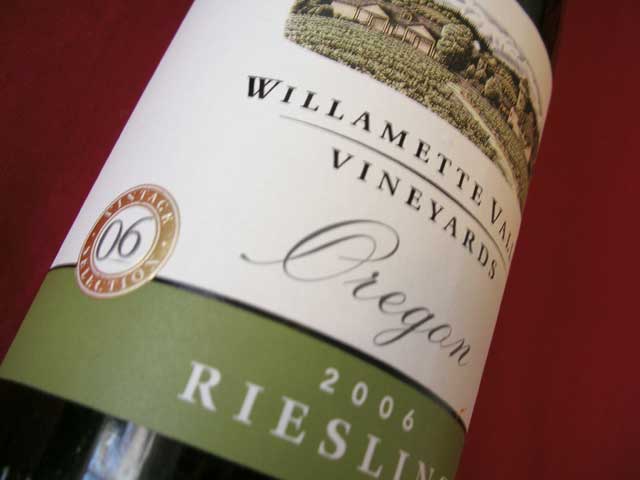
Willamette Valley Vineyards, Oregon Riesling, Vintage Selection, 2006

Oregon is bad. Stop it if you can. Here it comes. Here it comes. Now it's after you. Flee to some place new. Run away. Run away. - For the Wine Rambler it was too late. Oregon got me. And if you want to find out how it all happened and what this has to do do with one half of a team of almost-giants, well, then it got you too. Don't be afraid, though, it will all be revealed. And make sense. Sort of. Either way, there will be wine!

torsten Friday, 08/01/2010

Reinhold Haart, Wintricher Ohligsberg, Riesling Auslese, 2006

It was New Year's Eve and the Wine Rambler committee had assembled in Munich to drink some god-damn wine. And what could be better to conclude an evening of feasting and drinking with friends than one of the elegant, sweet Mosel Rieslings that Theo Haart turns out year after year? To celebrate the end of 2009 it had to be something special, an 'Auslese' ('selection', one of the highest ratings in the often confusing and not always meaningful German wine classification system). Made by a good winery and stored well these wines can last for decades, so a 2006 Auslese can almost be seen as a young wine when drunk at the end of 2009. Or as darn tasty, at any time.

Wittmann, Weißer Burgunder trocken "S", 2007

The Wittmann winery recently got a lot of attention from us - and what is not to like? A wine making family with lots of tradition (been in the business since 1663), unafraid to try new things (they went biodynamic five years ago), and, well, more than capable to deliver the thunder to your wine glass. The latest Wittmann in our collection is no exception here, even though it is not entirely without problems.

I opened the bottle of Weißburgunder (Pinot Blanc) because I was looking for a dry wine with a bit of substance to be strong yet delicate enough to go with roast partridge. What I got was almost more than what I bargained for, because this wine is indeed quite strong.