white

White wines reviewed by the Wine Rambler:

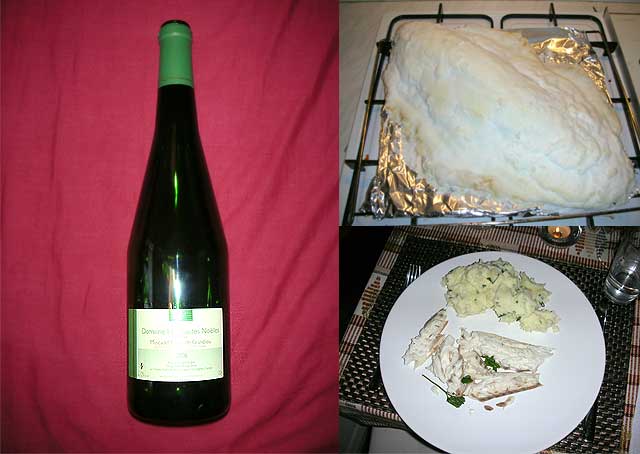
Domaine Les Hautes Noelles, Muscadet sur lie Côtes de Grandlieu, 2005

Certain ways of cooking fish and shellfish just cry out for a clean, light and crisp dry white wine - especially if you bake a whole sea bass in a salt crust. This is an excellent way to celebrate the delicate flavour of fish and it works well with a range of fish, including sea bream. Just put a little pepper and some herbs into the fish and then cover the whole fish in a dough made of salt, water and perhaps a few egg whites. This seals in all the moisture and preserves the delicate flavours of the fish. Serve the fish just with a bit of olive oil, pepper and salt, perhaps a little lemon and enjoy with very simple side dishes, perhaps just a few slices of white bread.

And make sure to select a wine that will not overpower the fish - I find a dry Muscadet works very well in this context.

torsten Friday, 25/12/2009

Knipser, Laumersheimer Kapellenberg, Riesling Kabinett trocken, 2008

When you see one of the Knipser brothers behind a table at a tasting, good-naturedly chatting with his customers while stoically pouring glasses for the thickening throng, there is nothing to suggest he might be anything more than another ruddy-cheeked wine grower from the Pfalz. And yet, the Knipser estate is arguably germany's most accomplished winery, in that they overachieve so consistently in every category and style - white and red, heavy and light, sweet and dry.

This one is light and dry, and, surprise surprise, perfectly made: Wonderful fresh acidity, clean, fragrant, slightly exotic Riesling fruit (think grapefruit and passion fruit), lean structure, light on the alcohol. Not deeply mineral or complex, but so flawlessly made it's a joy to drink.

Wittmann, Riesling trocken, 2008

London, so the MetOffice tells us, is about to descend into a snow chaos this night. While this may mean that tomorrow evening it will be time for hearty food with a robust red wine, tonight I felt more like spicy food and so I prepared a stir-fry. I use this simple recipe fairly often, it basically involves frying small bits of chicken breast in butter and then adding chopped peppers, green curry paste and lemon juice - the latter nicely balances the flavours and gives it that nice, fresh kick of acidity. So opening a Riesling seemed like the logical choice, and as the food was not overly spicy I thought I could get away with a dry Riesling. A particular bottle from the Wittmann winery had looked at me in this peculiar way for a couple of weeks now, so the choice was easy.

Heymann-Löwenstein, Schiefferterrassen Alte Reben, Riesling 2007

Imagine the Winesleuth comes to visit. Well, a good week ago fellow London-based wine blogger Denise did actually come over for dinner. And as Winesleuths and -ramblers cannot be without wine for too long, we had to taste two German Rieslings. One was the a deliciously sweet Riesling, the 2007 Goldtröpfchen Spätlese from the Haart winery, which was reviewed here before. The first was a Riesling too, but a dry one the Löwenstein winery. Here is what Denise had to say about it (so I guess this is our first guest-blog, in a way):

La Biancara, Pico, 2006

Most current wine marketing revolves around the attempt to associate wine with "nature", and to make not technical refinement, but true representation of the soil and the land the measure for wine quality. So you have your natural wine bandwagon on the one side, with your organic winegrowing, your biodynamics, your "slow" winemaking, your "natural wine". And then you have Natural wine with a capital N. And there you have your non-sulphurisers, your amphorae-diggers, your oxidizers, purists, extremists and experimentalists. Angiolino Maule from northern Italy's veneto is one of those. This wine is naturally fermented in open wooden barrels, not shielded from oxygen, unfined and unfiltered, with no added sulphur.

Weingut Seeger, Auxerrois, Heidelberger Herrenberg "AS" trocken, 2008

Whenever I drink a lightly (pleasantly!) oaked Chardonnay these days I think of Tom Aikens, a fine restaurant in South West London. I have not been there very often, but single time the sommelier surprised me with an unusual combination of food and wine and also with bringing out my (usually) hidden love for lightly oaked Chardonnay. The wine I have in my glass right now is not a Chardonnay and I am enjoying it at home, without the delight of Tom Aikens' food. Even so, it brings back some good memories. And it is not a Chardonnay, but an Auxerrois. Auxerrois is a relatively unknown and rare grape variety that can be quite similar to Chardonnay and Weißburgunder (Pinot Blanc).

Fürstlich Castell'sches Domänenamt, Casteller Hohenart, Silvaner Kabinett trocken, 2008

Sometimes I think that we should have a wine history segment on the wine rambler. Maybe we will some day. It should be fun to explore some of the microhistory in individual vineyard names, and to maybe get a grip on parts of the larger story of how the wine world that we know and love (well, some of it) came about. The breakup of large noble and monastic estates after 1803 within the crumbling holy roman empire would have to be such a period that changed the landscape of wine making beyond recognition. Or did it?

Lukas Krauß, Silvaner Kabinett trocken, 2008

Lukas Krauß, 21 years old, is a winemaker, no that's wrong, he is, proudly, a wine grower („Weinbauer“) from the Pfalz. And not the most prestigious part of the Pfalz, either. He is not listed in many wine guides nor will you have heard his name dropped in the wine blogosphere. But if you, like the wine rambler, are sometimes tired of the visual soft pornography and the worn out old clichés that are wine marketing, and want something that is personal, honest, stylish and funny, here is a name for you to remember, and here also is a site for you to look at:

http://www.lukaskrauss.de

We liked him instantly, and you will soon hear more from Lukas on the wine rambler, something that we look forward to very much.

Wittmann, Westhofener Riesling trocken, 2008

Wittmann needs no introduction, neither in the german wine scene nor on this site. They are well known as one of the leading lights from Rheinhessen, although it's always worth pointing out that they went seriously organic long before that became fashionable. The Westhofener is their mid-range dry Riesling, somewhere in between the single vineyard Große Gewächse and the simpler varietal QbA.

And you couldn't wish for better if, say, a friend had just fried a piece of tuna in a sesame crust for you:

Deep peachy Riesling fruit, razorlike yet ripe acidity, minerality, a great mixture of fruity power and mineral tension.

Another winner from an estate that seems incapable of making mediocre wine.

Georg Mosbacher, Deidesheimer Leinhölle, Riesling Spätlese trocken 2007

Yellow colour with a shiny golden sparkle - very promising. The nose even better: cool mineral, herbs, lemon and peach - very pleasant peach indeed, but not overwhelming, and some apple, which adds just the right amount of bitter. The peach continues right onto your tongue, giving the Riesling an elegant juiciness, while the apple and especially mineral dominate the first half of the long finish. A wine with good structure, elegance but also a certain assertiveness, Georg Mosbacher's dry late harvest Riesling convinces from start to finish - even two days after I opened the bottle it stays sharp and clear. What can I say, a really good wine!