Riesling

Knipser, Kalkmergel, Riesling Spätlese trocken, 2007

If you have read the Wine Rambler recently, you will have been introduced to the Knipser family as specialists for red wine - from Syrah to the Cuvée X, a blend of Cabernet Sauvignon / Franc and Merlot, the Knipser winery in Rhineland-Palatinate does it all. Among the many other grape varieties grown is Riesling, and today I have the distinct pleasure to write about a late harvest Riesling that is not only a great example of a dry, focussed white wine, but is also, I like to think, seriously good value.

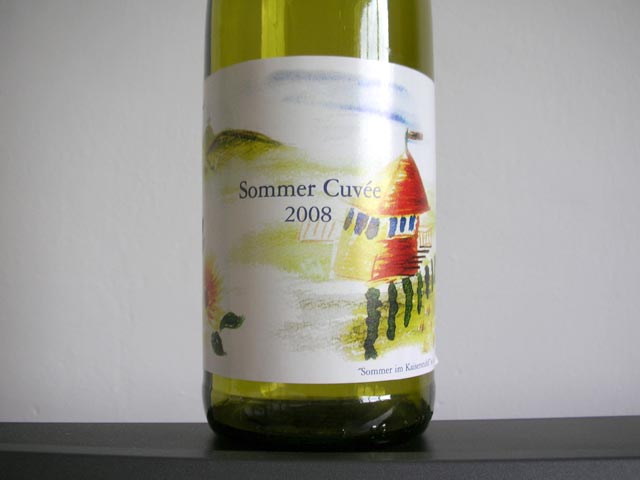
Salwey, Sommer Cuvée, 2008

One day it will become summer again. And when that happens you will want to drink a wine like this one here - or at least you should. The aptly named 'Sommer Cuvée' ('Sommer' being German for 'summer') is one of the basic wines of the Salwey winery. They make it from 95% Silvaner and 5% Riesling, two grapes the Wine Rambler loves. Together, they produce a light and fresh wine that is just a pleasure to drink.

Georg Mosbacher, Forster Elster, Riesling Kabinett trocken, 2007

When german Riesling is praised for its "finest perfume of fruit supported by a lightweight frame", it would seem that its ever-delicate balance must be so fragile that it would never survive contact with heavy, savoury food. Not so. To realise what Riesling can do with Sauerkraut, black pudding and liver sausage, you need to have tasted this classic german pairing* (do not, I repeat do not, take the Wine Rambler's word for anything).
For this, you need a Riesling that is dry rather than fruity, steely rather than floral, firm rather than ethereal. You need, in short, a dry Kabinett from the Pfalz. You also need good Sauerkraut and freshly made (raw, that is) sausages, of course. In what may simply be a local tradition or may have deeper and more sinister reasons of carnivore logistics, Munich butchers offer these every Friday.

Philipp Kuhn, Riesling Tradition, 2008

If you have ever come across the German village of Laumersheim, chances are it was because of a wine. Laumersheim is home to the Kinpser winery, a family owned estate that makes some of the best red wines you can get in Germany (and marvellous white wines too). And it is home to the Kuhn winery that is getting more and more attention, especially after Philipp Kuhn in 1992 - at the tender age of 20 - got involved in the family owned estate. You may be surprised to hear that the winery is not only producing some red wine, in fact about 50% of the wines made there are red. The delivery that brought this Riesling to London also included a Merlot! The story of red wine made by the Kuhns in the Palatinate will have to be told another night as tonight we are drinking the entry level Riesling from the Kuhn winery (entry level, by the way, does not mean mass-produced: harvests are limited to below 75 hl per hectare).

Matching food and wine: spicy food and sweet Riesling (example: pasta with carrot-chilli sauce)

Even if you do not know very much about pairing wine and food you might have heard that wine merchants often recommend Riesling with Asian or other spicy food. Or you might have come across a few wine labels that had similar suggestions. While certain wine labels do praise a wine as compatible with pretty much any food ('This wine goes well with salads, chicken, fish and various meats.'), there is indeed a connection between some spicy food and Riesling, especially sweeter Riesling. I will not exhaust this topic tonight, but I will give an example (with recipe) to illustrate how and why sweet (Riesling) and spicy (food) can go together, based on what may be the most important rule of food and wine pairing: match a wine with the sauce (not with the meat). So here it comes, a semi-sweet Riesling from the Mosel and pasta with a chilli-carrot sauce.

Ansgar Clüsserath, Trittenheimer Apotheke, Riesling Kabinett, 2008

Despite its pale lemon colour, this Riesling shines like gold (just in a light, quite pale lemon coloured way). It comes from the Mosel, from a vineyard near the village of Trittenheim, which is called 'Apotheke' - 'Pharmacy' in English (relating to the old-fashioned word Apothecary, of course). While I do normally not go so far as to recommend a wine as medicine, with this one I almost might - it is just such a refreshing joy to drink it.

The nose with its mineral and herbs makes me think of, well, the steep vineyards of the Mosel; add to that refreshing green apples, peach and half-fermented fruit and then finely dust the aromas with icing sugar. A bouquet that says: 'drink me, drink me now!'

torsten Wednesday, 13/01/2010
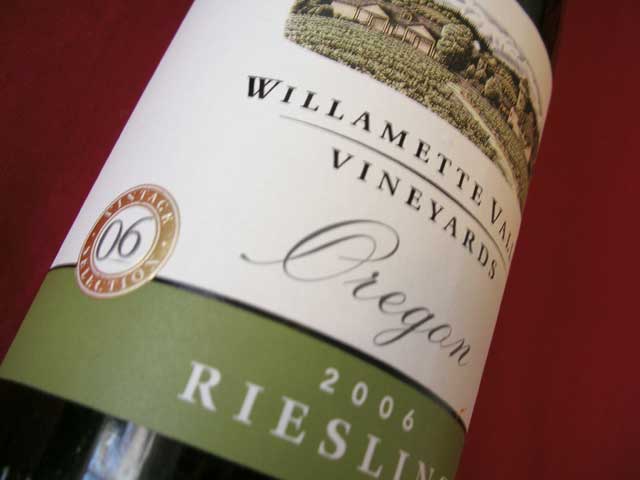
Willamette Valley Vineyards, Oregon Riesling, Vintage Selection, 2006

Oregon is bad. Stop it if you can. Here it comes. Here it comes. Now it's after you. Flee to some place new. Run away. Run away. - For the Wine Rambler it was too late. Oregon got me. And if you want to find out how it all happened and what this has to do do with one half of a team of almost-giants, well, then it got you too. Don't be afraid, though, it will all be revealed. And make sense. Sort of. Either way, there will be wine!

torsten Friday, 08/01/2010
Top 5 (German) wines of 2009

2009. London is hit by snow twice. Usain Bolt breaks the record in breaking world records. A German chancellor is re-elected and a German goalkeeper decides to go. The Royal Bank of Scotland announces a loss of £24.1 billion. Swine flu strikes; or so. British MPs spend money on moats and birdhouses. And the Wine Rambler drinks some wine. Quite a bit, actually, especially considering that we only launched the website in June 2009 (after having rambled between Munich and London via email for more than two years). And while others may still look back at what happened in sport, politics or the economy, we remember five wines that really impressed us last year. Here they come, the Wine Ramblers' top 5 wines of 2009:

torsten Tuesday, 05/01/2010

Reinhold Haart, Wintricher Ohligsberg, Riesling Auslese, 2006

It was New Year's Eve and the Wine Rambler committee had assembled in Munich to drink some god-damn wine. And what could be better to conclude an evening of feasting and drinking with friends than one of the elegant, sweet Mosel Rieslings that Theo Haart turns out year after year? To celebrate the end of 2009 it had to be something special, an 'Auslese' ('selection', one of the highest ratings in the often confusing and not always meaningful German wine classification system). Made by a good winery and stored well these wines can last for decades, so a 2006 Auslese can almost be seen as a young wine when drunk at the end of 2009. Or as darn tasty, at any time.