

dry
These wines are dry, or 'trocken' in German terminology, - either according to our palate or the classification of the winery.

Van Volxem, Scharzhofberger Riesling, 2008
You have never heard the name 'Scharzhofberg' before? Well, take a pen (or a keyboard) and write it down. Scharzhofberg is the name of a German vineyard, located near the Saar river (close to the Mosel). There are of course many vineyards in Germany, but Scharzhofberg has an excellent reputation and may be one of the most expensive bits of real estate in German winemaking - if you could buy land there, as producers jealously guard every square meter they own. Land rarely changes hands there, but the Van Volxem estate is lucky enough to own a small part of the 28 hectare vineyard. So let's have a look at what they can do with it, shall we?

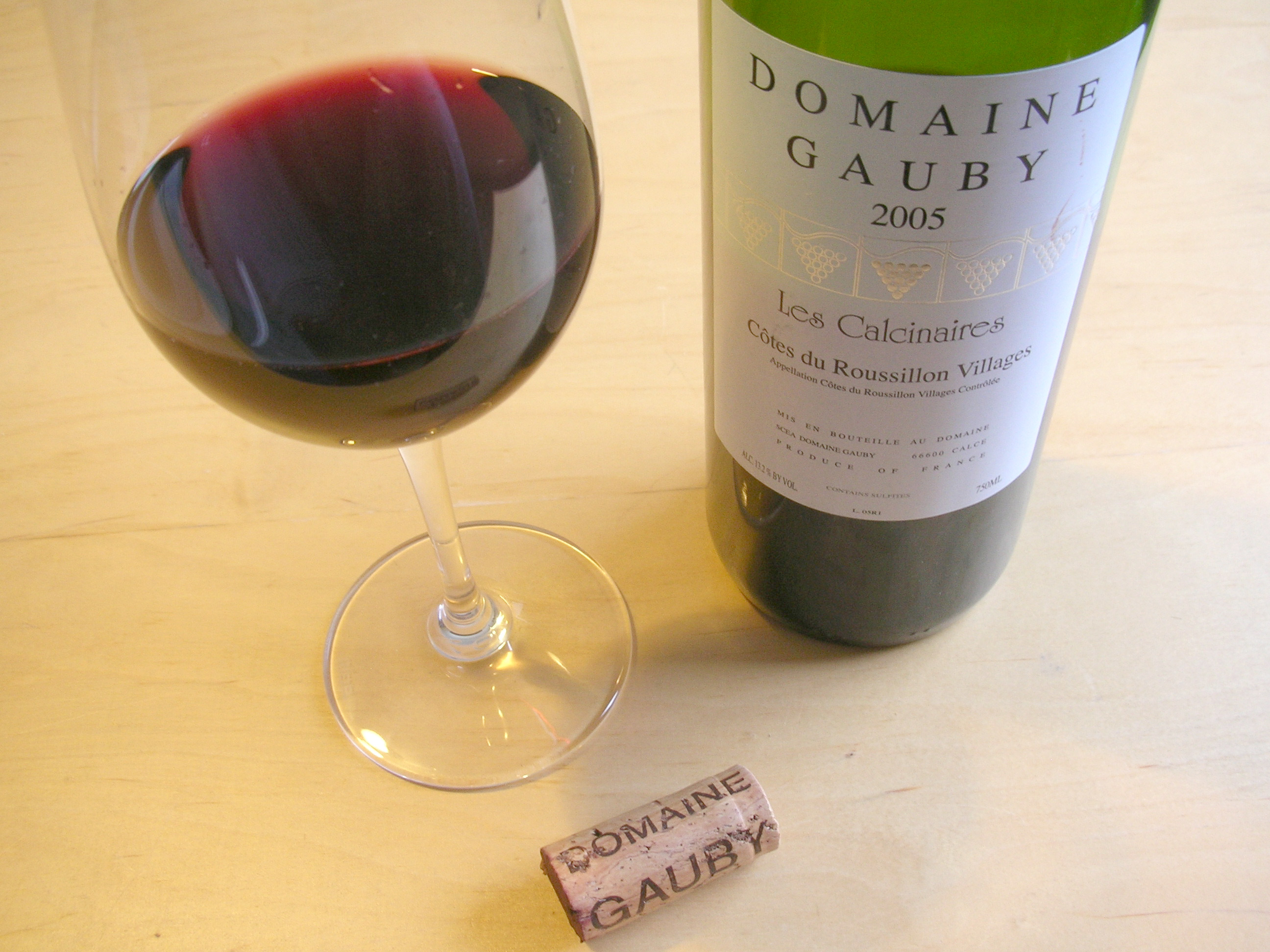
Domaine Gauby, Les Calcinaires, Côtes du Roussillon Village, rouge 2005
Wine, it seems, is still getting more and more alcoholic, a trend to which climate change happily contributes. After all, there is not much that producers can do against rising temperatures. Or is there? Gérard Gauby, a Roussillon winemaker, seems to believe they can. A decade ago he switched to biodynamic winemaking and successfully developed methods to reduce the alcoholic strength of his wines.
I had a 2005 Gauby sitting in my wine rack for a while now, until Julian kicked me into action by commenting on Gauby's 2004: 'Aromatics of overripe plum and dried herbs, but fairly imprecise and unfocused, with sweet and oxidised port notes that didn't work for me. I think very highly of Gauby, but this one doesn't seem to age well. Or maybe a reminder that "natural" wines are at all times capricious, moody fellows?' After reading this it seemed high time to drink up my 2005, in case it had suffered a similar fate. Had it?
Salwey, Riesling Eichberg GG, 2008
Germans love dry wine - this still comes as surprise to many foreigners who think of Germany as country of sweet wine. Actually, almost two thirds of all wine produced in Germany is dry. On top of that the VdP, the association of top producers, are currently pushing for a new top category in the wine classification system that applies to dry wine only. This is where the label 'GG', short for 'Großes Gewächs' (literally 'great growth') of today's Riesling from Baden comes from.
In order to be classified as GG, a wine has to come from a certified top vineyard, yields have to be low, only grape varieties that have some tradition in the region can be used, grapes have to be harvested selectively by hand and the wine has to have the same quality level as a late harvest. And, of course, the producer has to be a member of VdP. The Baden winemaker family Salwey are, and this is their 2008 GG Riesling.

Vincent Carême, Vouvray Spring, 2007
When 2009 came to an end, for some reason the Wine Rambler got infected with the idea of developing new year's resolutions. Among the ones Julian came up with was to 'try more from lesser-known French wine regions like the Jura or the Loire Valley'. Traditionally, I leave France more to Julian, but his recent excitement about a Loire Chenin Blanc made me memorise the word 'Vouvray'. Vouvray is a region of the Loire Valley where they specialise in Chenin Blanc, wines that can rival Riesling in terms of their potential to age for decades. So when (following a phase of drinking much Pinot Blanc, Riesling and some Chardonnay) I came across a Vouvray that was recommended by trustworthy wine merchants Philglas & Swiggot, I did not hesitate and grabbed their last bottle. Lucky me, I can now say.

Descendientes de J. Palacios, Petalos del Bierzo, 2004
Wine rambling-wise, Spain has not been among my preferred hunting grounds. As with Italy, I've not yet figured out what makes it tick as a wine country, and some of the more stream-lined reds I've tried have not encouraged me to invest more energy. Which is my loss, as afficionados and Spain experts will be quick - and correct - to point out. A notable exception over the last few years has been this red that Alvaro Palacios (of Priorato fame) makes from the Mencia grape in the little known northern Spanish region of Bierzo. This was the last of three bottles, and none of them failed to satisfy. So here's making it up to Spain:

Wittmann, Chardonnay trocken, 2007
It is still Chardonnay time here at the Wine Rambler. Following some of my recent 'foreign' Chardonnay adventures, I decided it was time to go back to what Germany has to offer. This time the journey leads to Rheinhessen, where Philipp Wittmann goes from strength to strength with his biodynamic wines (yes, outstanding Riesling, but not only Riesling). What about his Chardonnay?

Dr. Heyden, Oppenheimer Schloss, Frühburgunder, 2007
Today, we continue our exploration of under-the-radar grape varieties in german wine by introducing Pinot Noir's little brother (come on out, don't be shy): Frühburgunder literally translates as "early Burgundy", so we are dealing with a particularly early-ripening member of the Pinot family. Like any precocious child, this small-berried variety can be difficult to raise, but promises great complexity and aromatics once it really comes into its own. In France, it is known as Pinot Pommier or Pinot Madeleine - except that it isn't really, because it is routinely blended with Pinot Noir without declaring this on the label. In Burgundy, for example, it is often not even known in which of the older Pinot vineyards it exists, and in what proportion. Such ignorance is not for us systematically-minded Germans, of course, and in the 1970s, a winemaking college sent out researchers with clipboards, pens behind their ears (as I like to imagine it), into the vineyards to find out. One of the places where they were pleased at what they found must have been Dr. Heyden's vineyards in Rheinhessen, which have given us this excellent example for the grape's qualities: 
After several not overly successful ventures into UK supermarket wine I have let my investigation into what is available on the mass market slip. The other day though in Sainsburys I came past an Austrian wine that looked really interesting. And so I grabbed a bottle and was rewarded with one of the best wines I have ever bought from a supermarket. If you are bored by cheap Australian or Italian wines and look for a good refreshing white then look no further and go for Austria this summer.

Sutor, Chardonnay, 2006
When it comes to wine, it is always worth keeping an eye on central and eastern Europe. When browsing the shelves at Philglas & Swiggot the other day I remembered this maxim and went for a highly recommended Chardonnay from a Slovenian winery. Sutor are located in the Vipava Valley, an extension of the Friuli. Charonnay is quite popular there, as it is in Slovenia in general (where it is the most planted white variety), and as I had not had a Chardonnay in a while, I took the Sutor home with me.
