the wine-growing estate

<p>Buying directly is usually a little cheaper than going through a merchant, you get a better range of wines and may also develop a relationship with the winemakers/owners. Altogether: highly recommended!</p>

<p>Below are the wines that we bought directly from a wine-growing estate. Below the descriptions you will find the name of the estate listed as the first tag.</p>

Dr. Heyden, Oppenheimer Schloss, Frühburgunder, 2007

Today, we continue our exploration of under-the-radar grape varieties in german wine by introducing Pinot Noir's little brother (come on out, don't be shy): Frühburgunder literally translates as "early Burgundy", so we are dealing with a particularly early-ripening member of the Pinot family. Like any precocious child, this small-berried variety can be difficult to raise, but promises great complexity and aromatics once it really comes into its own. In France, it is known as Pinot Pommier or Pinot Madeleine - except that it isn't really, because it is routinely blended with Pinot Noir without declaring this on the label. In Burgundy, for example, it is often not even known in which of the older Pinot vineyards it exists, and in what proportion. Such ignorance is not for us systematically-minded Germans, of course, and in the 1970s, a winemaking college sent out researchers with clipboards, pens behind their ears (as I like to imagine it), into the vineyards to find out. One of the places where they were pleased at what they found must have been Dr. Heyden's vineyards in Rheinhessen, which have given us this excellent example for the grape's qualities:

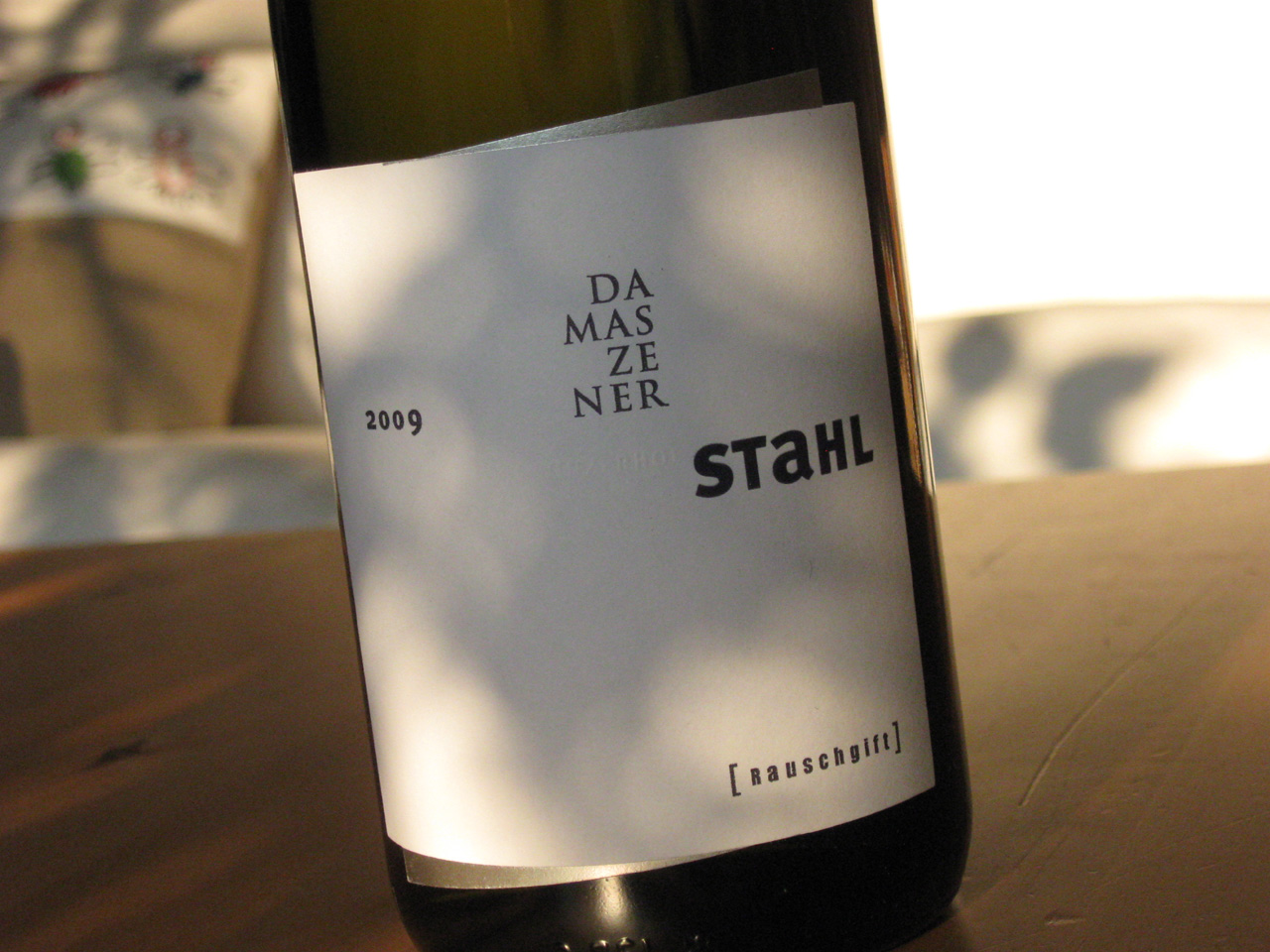
Winzerhof Stahl, Scheurebe "Damaszenerstahl", 2009

After more than one year of rambling across the homely green landscape of german wine, there are still a great many places the Wine Rambler has hardly even begun to go. Among them, the many white grapes outside the Riesling-Silvaner-Pinot triangle: One, the ubiquitous, but not-quite-so-banal Müller-Thurgau, we will investigate in some detail in the coming weeks. Another omission is Scheurebe. Scheurebe like this one here, made by Christian Stahl, one of the most interesting and ambitious young vintners of Franken:

Reinhold Haart, Piesporter Grafenberg, Riesling Kabinett, 2008

When you put your nose into a glass of wine and it smells a little bit like a car dealership, but in a good way, you can be fairly certain that you have a Riesling in front of you. This Haart Riesling from the Mosel is not one of the petrol noses, so please don't think of a garage wit lots of oil and grease, but its bouquet has a little of the more refined version of that smell, just think of a BMW car dealership salesroom. Or rather walking through one while eating a peach.

torsten Wednesday, 23/06/2010

Dr. Heger, Ihringer Winklerberg, Spätburgunder ***, 2000

If you are one of those thinking of German Pinot Noir as very light wine, pale in colour and neither substantial nor worth ageing then have a look at the wine below. And if you do not think about German red wine at all, well, then do the same. The two Wine Ramblers, at any rate, did also spend some time looking in amazement at the incredibly rich colour of the ten year old Spätburgunder that they had opened last weekend to celebrate one year of The Wine Rambler. Join us in the merriment:

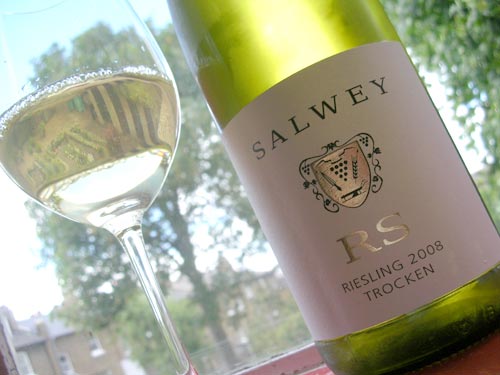
Salwey, Riesling RS trocken, 2008

If it comes to the Salwey winery, we have so far mostly sampled their range of excellent Pinots - Noir, Gris/Grigio and Blanc. Located in the warmest area of Germany, the volcanic Kaiserstuhl in the South West, the Salwey vineyards are very well suited for growing Pinot. As it turns out, they also make good Riesling there, and I had one of them recently with a nice piece of fish and English asparagus.

Reinhold Haart, Piesporter Goldtröpfchen, Riesling Auslese, 2006

Recently, I found myself drinking with friends who were discussing which type of vegetable they would like to be. When I asked them how they would rate me, Charlotte suggested I could be a squash. Unfortunately I never really found out why she classified me in this way, partly because she went on to say she would quite like to be a courgette. Today's wine, luckily, is not like a vegetable. Instead it is very easy to describe in terms of fruit: take the most deliciously juicy peach you can imagine, add passion fruit, and caramelise it with lots of sugar and some gold, sprinkle finely with herbs and serve in a stony cup with a dash of menthol, spice and lemon juice. As you can see this description really does not work in relation to vegetables, but I can tell you that if this wine were a human being it would have to be the young Liv Tyler - just in blond.

Martin Müllen, Kröver Paradies, Riesling Auslese trocken, 1990

One of the less exciting things about living in London is not having a cellar. I sometimes feel a certain envy towards friends on the continent who 'of course' have a cellar and can put age-worthy wines away for a few years or even decades. So whenever I can get my hands on an aged wine I get pretty excited. Quality Riesling, particularly the sweeter ones, can age very well, but if you buy a twenty year old one it is always a gamble. Luckily, I got this one directly from the winery, so I was fairly certain it had been stored properly. Ladies and gentlemen, I present a good ol' boys Riesling from the Moselle:

Weingut Schnaitmann, Muskattrollinger Rosé, 2009

Before we give this unexpectedly gorgeous rosé from - get this - Württemberg its due, a word about its grape variety: Muskattrollinger is a cross between - you'd never have guessed it - Trollinger and Muscat that has been grown in Württemberg since the mid 19th century. Trollinger is the signature grape of Württemberg and usually produces very light, unmistakeably fruity reds - usually. Muscat is well known and adds its trademark floral explosiveness to the genetic mix.

And what a mix it is: It starts with an appetising salmon-copper-colour. It has red and white currants (yeah, get the white currants), gooseberry, elderberry and orange in its smell, and great fresh acidity and intensive spicy and floral fruit flavours in its taste. Wonderfully light on the alcohol as well. We are not known as the world's greatest rosé advocates here at the Wine Rambler, but you simply need to call a killer wine a killer wine.

Reinhold Haart, Wintricher Ohligsberg, Riesling Großes Gewächs, 2008

The Haart winery is a Wine Rambler regular, constantly winning our praise for their elegant and sophisticated sweet Riesling. However, they are also producing a small quantity of dry Riesling, of which we so far shockingly have only reviewed one. This is to change today.

A simple way of describing the bouquet of the Haart Riesling would be to say that it features stone fruit, lemon, mineral, yeast and a hint of vegetable and tobacco. A much better way of describing it would be to ask you to imagine finding an old tobacco chest in a cool, somewhat damp, loamy cave. The bottom layer of the chest would be covered with ground stone and earth, generously sprinkled with lemon juice and pieces of stone fruit - and all of that covered with a wet, mineral heavy ball of cotton wool soaked in yeast.