the wine-growing estate

<p>Buying directly is usually a little cheaper than going through a merchant, you get a better range of wines and may also develop a relationship with the winemakers/owners. Altogether: highly recommended!</p>

<p>Below are the wines that we bought directly from a wine-growing estate. Below the descriptions you will find the name of the estate listed as the first tag.</p>

Reinhold Haart, Piesporter Goldtröpfchen, Riesling Kabinett, 2008

On a glorious, sunny day (or, in this case, quite a few hours after the sun went down after such a day), not much beats a glorious, sunny Riesling, in particular if it is so very quaffable and yet elegant as this one. Yes, I am again drinking one of the fruity Rieslings made by Theo Haart, this time a lighter wine in 'Kabinett' style.

torsten Thursday, 29/04/2010

Salwey, Sekt Rosé Brut nature, 2004

Recently, I have been drinking quite a few Salwey wines, both red and white. So far the wines from the sun-kissed south-west of Germany have entertained me very well, so it was time to try a sparkling Salwey - even more so as I had a few friends over the other night who had not yet tried a German sparkler. Time to change that!
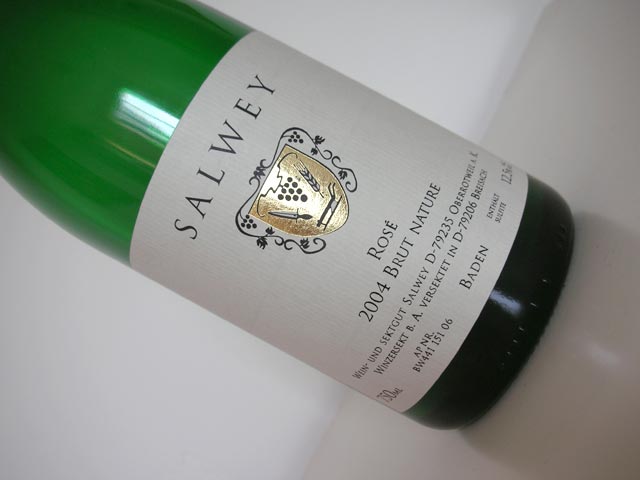
Pop, went the cork and a wonderfully bubbly sparkling wine of the most amazing amber colour foamed into our glasses. I don't think I have seen such a wonderful deep amber in a wine, it was just perfect. One of my British friends described the colour, and this reference may be lost on many, as 'not quite Irn-bru'. This was a most promising start!

Martin Müllen, Kröver Letterlay, Riesling Spätlese, 1994

A nicely aged Riesling can be a wonderful thing. Unfortunately, for those not blessed with a proper cellar storing wine for a decade or two is a risky venture. This makes buying aged wine directly from the winery very interesting, especially when the wine comes at a reasonable price. Of course, there is also the risk that they are trying to dump rubbish they couldn't sell on you, but for €12.90 and coming from a good winery I thought I could take my chances with this half-dry late harvest Riesling from the Moselle:

Staatsweingut Meersburg, Meersburger Chorherrnhalde, Weißburgunder trocken, 2008

Wine produced and sold by the state? No, we're not talking about socialist eastern europe in the 1980s, we are talking the German federal Länder, who, for good historic reasons [*] own and operate large wine estates. Thus, the fine free state of Bavaria has the Staatlicher Hofkeller in Würzburg, the Land of Hessen its Staatsweingüter Kloster Eberbach. But for this time, it's Baden-Württemberg's own winery in Meersburg, Lake Constance, that makes bureaucratic beverages look good. How good? Well, here is the winery headquarters, for starters:

Reinhold Haart, Piesporter Goldtröpfchen, Riesling Spätlese, 2008

If you ask me to name a winemaker who has really impressed me with consistently, year for year letting the quality (let's avoid the word terroir here, shall we) of an outstanding vineyard shine, well, then I would probably name Theo Haart. Sure, there are others, but I have now tasted his late harvest Rieslings from the famous Piesporter Goldtröpfchen for the vintages 1999 and 2001-2008 (the 05 though is still sitting here, waiting for its day), and not only are they all first class wines, they are also very distinct and consistent in style. The '08 is no exception and, boring as it may sound when I write about Haart late harvest Riesling, just a lovely wine.

Reinhold Haart, Piesporter Goldtröpfchen, Riesling Spätlese, 2003

It has been a while, way too long, actually, since I reported on a wine made by the lovely people from the Haart winery. The winery is based in the village of Piesport, a name that is infamous in the UK for cheap wine, but famous among wine lovers for the Goldtröpfchen (little drop of gold) vineyard, one of the best at the Mosel. The Haart family has been making wine since the 14th century and the sweet Rieslings of Theo Haart, who runs the family estate with his wife and son, have an excellent reputation. For me they are also the embodiment of what I love about the Mosel style of winemaking.

Salwey, Weißburgunder & Chardonnay, 2008

I have written about so many Salwey wines recently, I almost feel bad to pay that much attention to a single producer. Almost, I said, because Salweys know what they are doing and I am in a Pinot (Noir, Blanc, Gris) phase anyway. So I will keep it sweet and short today in order not to repeat myself. Here it is, a blend of Chardonnay and Pinot Blanc/Weißburgunder:

Salwey, Grauburgunder Kabinett trocken, 2008

After two years of mostly going for Riesling, I currently find myself drinking more and more Pinot, specifically Pinot Blanc and Gris. Well, surprise, this is another of those bastards, and despite being made from the same grape variety it is not exactly like your average Italian Pinot Grigio. It is Grauburgunder time, and yet again am I turning to the warm South-West of Germany, to enjoy a wine from the Kaiserstuhl region.

The first thing to notice about it is the colour. Colour is always difficult to capture well in a photograph, and this one does not quite bring across the fairly dark, gold-brown that the Salwey wine radiates. Pretty, really pretty.