the wine-growing estate

<p>Buying directly is usually a little cheaper than going through a merchant, you get a better range of wines and may also develop a relationship with the winemakers/owners. Altogether: highly recommended!</p>

<p>Below are the wines that we bought directly from a wine-growing estate. Below the descriptions you will find the name of the estate listed as the first tag.</p>

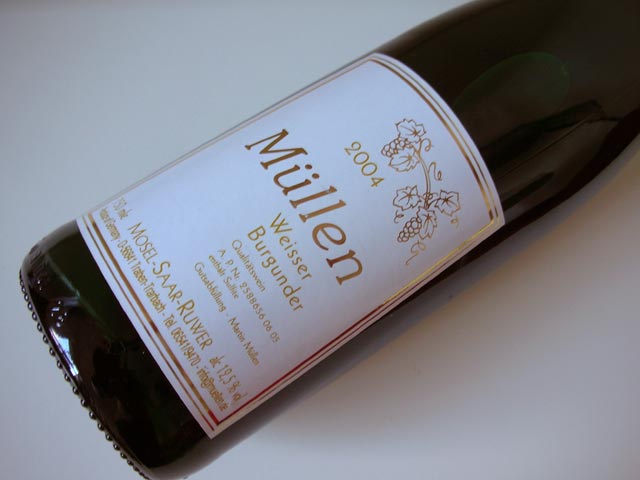
Martin Müllen, Weißer Burgunder, 2004

I cannot drink, or even think of, this wine without the memories coming back. It was a couple of years ago, and almost summer, and the Wine Rambler committee visited the Mosel. One of our stops was the village of Traben-Trarbach, where we visited the Müllen winery - and we got more than we bargained for. The full story is better to be told over a glass of Riesling, but very generous tasting samples that kept and kept and kept coming are part of it. And stories that kept and kept and kept coming. And there was a bit about a cat. We sampled many Rieslings that day, different styles too, and also a few other varieties. Among them was an impressive Pinot Blanc, a Weißburgunder, and today I opened the last bottle.
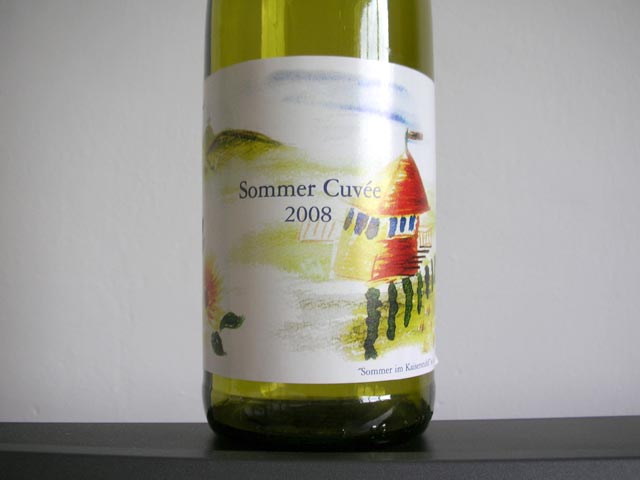
Salwey, Sommer Cuvée, 2008

One day it will become summer again. And when that happens you will want to drink a wine like this one here - or at least you should. The aptly named 'Sommer Cuvée' ('Sommer' being German for 'summer') is one of the basic wines of the Salwey winery. They make it from 95% Silvaner and 5% Riesling, two grapes the Wine Rambler loves. Together, they produce a light and fresh wine that is just a pleasure to drink.

Salwey, Oberrotweiler Käsleberg, Spätburgunder 2008

It is time again to drink a Salwey wine - this time with Borough Wines and the Winesleuth as part of my mission to spread the word on German wine. Salwey is a producer I really like. Based in the hot South-West of Germany, they specialise in Pinot (Noir, Gris, Blanc), but do also demonstrate that you can make good Riesling and Chardonnay in the hot, volcanic area of the Kaiserstuhl.

This Pinot Noir comes from the Oberrotweiler Käsleberg, a terraced vineyard with loam soil that is said to produce wines that develop quickly and have an elegant note to them. Is this reflected in the Spätburgunder in front of us?

Markus Molitor, Wehlener Klosterberg, Weißburgunder *** trocken, 2005

Uncertain what you are looking at here? Somehow strangely attracted yet also confused? Doubtful whether this actually belongs on a wine blog?

If this is what you feel looking at the above picture then welcome to my world of confusion and doubt about a wine of which I am not sure if it should exist at all. What do you do with a wine clocking in at 15% alcohol? How do you feel when you realise it is a white - and from one of the coolest wine regions of a cool wine growing country? Should Mosel winemakers really do this? Should any (white) wine be so strong? Is it actually drinkable? If you want a definitive answer to these questions, please do not read on.

Palivou Estate, Ammos, 2006

Read the background story to this wine here (be warned: It's quite a ramble)

A very dark cherry red in the glass, this brought sweet cherry juice, blackberries and a little fruit jam to our noses. The mouthfeel is, again, dominated by marinated cherries, dried fruit, and a chocolate pudding aftertaste.

It's a measure of the quality of the winemaking that this overripeness does not pull it out of balance, but a gentle tannic backbone wraps up the taste in the end.

Julian Monday, 04/01/2010

Reinhold Haart, Wintricher Ohligsberg, Riesling Auslese, 2006

It was New Year's Eve and the Wine Rambler committee had assembled in Munich to drink some god-damn wine. And what could be better to conclude an evening of feasting and drinking with friends than one of the elegant, sweet Mosel Rieslings that Theo Haart turns out year after year? To celebrate the end of 2009 it had to be something special, an 'Auslese' ('selection', one of the highest ratings in the often confusing and not always meaningful German wine classification system). Made by a good winery and stored well these wines can last for decades, so a 2006 Auslese can almost be seen as a young wine when drunk at the end of 2009. Or as darn tasty, at any time.

Lukas Krauß, Krauße Schwarzer, 2008

Winter evenings, we are constantly reminded, are the time to open the big reds, bring out the big guns, release the heavy hitters. That may be so, but light, elegant reds that do not clobber the food or the taster are always in season.

From Blauer Portugieser (a red grape once common across Germany, Austria and eastern Europe but now declining), and Schwarzriesling (nothing to do with Riesling, but Pinot Meunier, of blanc-de-noirs champagne fame), Lukas Krauß makes this wonderfully bright cherry-coloured wine, named in honour of his grandfather.

Lukas Krauß, Silvaner Kabinett trocken, 2008

Lukas Krauß, 21 years old, is a winemaker, no that's wrong, he is, proudly, a wine grower („Weinbauer“) from the Pfalz. And not the most prestigious part of the Pfalz, either. He is not listed in many wine guides nor will you have heard his name dropped in the wine blogosphere. But if you, like the wine rambler, are sometimes tired of the visual soft pornography and the worn out old clichés that are wine marketing, and want something that is personal, honest, stylish and funny, here is a name for you to remember, and here also is a site for you to look at:

http://www.lukaskrauss.de

We liked him instantly, and you will soon hear more from Lukas on the wine rambler, something that we look forward to very much.

Clemens Busch, Vom Roten Schiefer, Riesling, 2006

Perhaps unusually for a Mosel winemaker, Clemens Busch is well known for his dry Riesling - he also makes off-dry and sweet wines, but when we visited the winery in 2008 I mostly brought home dry wines. Vom Roten Schiefer - "from red slate" - was one of them.

All starts with a nice golden colour and a nose of a mineral, stone fruit (peach and plum), camomile tea, honey and paraffin wax. All of that made for a substantial, matured impression. On the tongue the Riesling is quite full-bodied and a well rounded, caramel richness. Exotic fruit and ripe plum mix well with noticeable, fresh acidity and a kick of spice. A rich yet elegant wine with a little attitude.

Markus Molitor, Molitor Spätburgunder "R" trocken, 1999

Some wines are waiting for a special occasion. My Pinot Noir "R" from the Molitor winery had been waiting almost ten years for its time to come (although most of it in the cellars of the Molitor estate at the Moselle) - until a friend invited me to Oxfordshire for an autumn Sunday in the countryside, including a braised duck. So off I went, and the Pinot Noir from the Moselle came with me. And boy was it worth the wait (although I am not sure if the wine really cared as much about it as we did).

Traditionally, the Moselle - or Mosel, as the German call it - is known as the home of the German Riesling, especially the lighter, fruitier and sweeter Riesling that regularly wins high ratings in international wine challenges. However, since the 1980s or so, red wine has slowly made its return. Molitor started planting Pinot Noir about 20 years ago and has received a lot of praise for his Spätburgunder, also from the Wine Rambler. This is not only the oldest Molitor wine for us to review so far, but also the oldest Pinot Noir.