the wine-growing estate

<p>Buying directly is usually a little cheaper than going through a merchant, you get a better range of wines and may also develop a relationship with the winemakers/owners. Altogether: highly recommended!</p>

<p>Below are the wines that we bought directly from a wine-growing estate. Below the descriptions you will find the name of the estate listed as the first tag.</p>

Ludwig Thanisch & Sohn, Lieserer Niederberg Helden, Riesling Spätlese Feinherb, 2007

Dark straw colour.
A nose of candied lemon and orange peel, with slate minerality and a tiny bit of vegetal roughness.
Candied lemon peel and "slate" are also prominent in the taste, with a hint of bitterness on the finish.

This very enjoyable Riesling from an up-and-coming producer ranges between the the lighter "traditional" mosel off-dry style and the more opulent and creamy "harmonic dry" created by the likes of Reinhard Löwenstein, Van Volxem and Clemens Busch. Not a bad place to be.
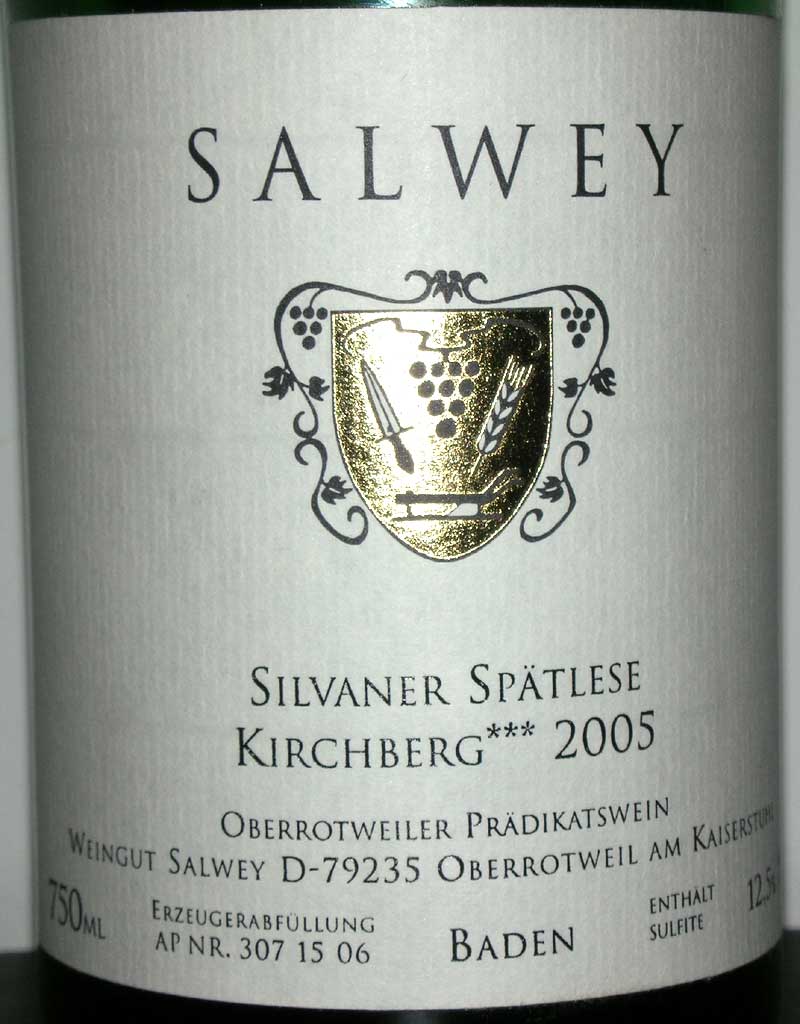
Salwey, Silvaner Spätlese, Kirchberg *** 2005

It is still 2009, the year of the Silvaner grape in Germany - and the Wine Rambler is of course drinking Silvaner. After a full committee meeting last Saturday enjoyed an outstanding Silvaner from Franconia, the London branch of the Wine Rambler jumped right back into Silvaner, this time with a more aged wine - another outstanding example of what a competent winemaker can do with this grape.

Juliusspital, Würzburger Stein, Silvaner Großes Gewächs, 2008

Large wineries owned by immensely land-rich historic trusts are a typical feature of the franconian wine scene, especially in Würzburg. As these go back to charitable - or not so charitable - institutions founded in the late middle ages or the 16th century, they have had some time to accumulate land, assets and reputation. By running wineries alongside hospitals (that's where the "spital"-part comes from), nursing homes and real estate operations, they preserve a forgotten model of business, social services and agriculture whose usefulness must have seemd self-evident to citizens in many premodern cities.

Weingut Dr. Heyden, Silvaner trocken, Alte Reben, 2007

The wine rambler continues its Silvaner coverage, today with a specimen from Slovenia - that's right, the Wine Rambler has been looking east lately, more on that soon - and this one here from good old Rheinhessen:

Fairly dark straw colour, not quite golden.
Nose of dried apple slices, but also ripe grapes, a little floral too, making me think, unexpectedly, of Gewürztraminer.
In the mouth it's candied apple again, mature fruit, quite some weight and length, noticeable sweetness, although 5 grams per litre of residual sugar make it legally dry. Very mild acidity.

Markus Molitor, Wehlener Klosterberg, Spätlese, Riesling Feinherb, 2005

The very discreet notes of tobacco in the nose of this wine went almost unnoticed when I opened the bottle yesterday to go with a raspberry desert - but that was simply because of the quite intense raspberry smell dominating the table. Despite the fruity dessert we could easily pick up apple, peach and herbs, embedded in a fresh, mineral creaminess. A very pleasant nose coming from this 'feinherb' (=off-dry with perhaps a bit more acidity) Mosel Riesling - and a very good reflection of the sensation awaiting your taste buds. The apple is perhaps a bit more dominant on the tongue than the nose; the Riesling manages to be both smooth and a little rough (in terms of acidity think more vegetable/apple than citrus fruit) with firm minerality, good structure and a nice finish.

Fürst Hohenlohe-Oehringen, Verrenbergerer Verrenberg "Butzen", Lemberger trocken 2007

The winery Fürst Hohenlohe-Oehringen has already impressed the distinctly non-aristocratic wine rambler with its marvellous top-of-the line red "Ex flammis orior". And the Lemberger red wine grape of Württemberg, as our regular readers know, is no other than Austria's and Hungary's Blaufränkisch. In the new spirit of german patriotism summoned by german liberal democrat and possible future foreign (!) minister Guido Westerwelle, who refused to answer an english question from a BBC reporter with the witty and adroit words: "Wir sind ja hier in Deutschland", we should probably not even tell you that. So, let's turn to a german wine from a thoroughly german grape:

Weingut Bercher, Burkheimer Feuerberg, Weißburgunder Kabinett trocken, 2007

The wine rambler could not agree more to the statement from the excellent german WeinPlus online wine guide "Year after year, Bercher impresses us with their completely unpretentious, yet deep and expressive wines".

This mid-range single vineyard Pinot Blanc justifies the praise with effortless precision wine making: Dense straw colour, a nose of caramel, buttered biscuits and melon juice spilled over hot stones. Dense, polished fruit in the mouth, mineral background, good acidity, and above all, a freshness and drinkeability that is not a matter of course, the Kaiserstuhl almost having turned into a hot-climate wine region in recent years.

Reinhold Haart, Piesporter Goldtröpfchen, Riesling Großes Gewächs, 2007

Three bottles. I managed to get my greedy hands on three bottles of this wine last year - regular readers of the Wine Rambler will know that I am a big fan of the lovely wines Theo Haart creates at the Haart family estate overlooking the Mosel river. Most of the wines are sweet, but every year there are a few bottles of dry wines. 'Großes Gewächs' is German for 'great growth' and indicates that you are drinking a dry wine from a top vineyard as certified by the German Association of Premier Winemakers (VdP). Basically, think of it as a dry Spätlese (late harvest) or Auslese. So three bottles. One went down the drain last weekend because it was corked - it tasted of burnt smoke and vinegar. This means I am now down to two.

Fürst Hohenlohe Oehringen, "Ex flammis orior", 2006

Württemberg, Swabia, home of the gleaming Mercedes Benz, the Bausparvertrag, the Kehrwoche and the Häuslebauer (untranslatable terms, because they describe specific anthropological phenomena). And wine country. Many a railroad passenger passing by the beautiful and spectacularly steep vineyards around Stuttgart may have wondered why these wines are consumed avidly by Württembergers themselves, but, too often uninspired and uninspiring, given the cold shoulder by the rest of the wine world.

Reinhold Haart, Piesporter Goldtröpfchen, Riesling Spätlese, 2004

Is there anything better than a nicely aged, excellent Riesling? I am not sure, but drinking this late harvest from winemaker Haart makes me think there may not be many things that would be better.

The colour is just beautiful, shiny gold with a hint of green. The nose is sophisticated, juicy peach with light herbal notes, cool, buttery mineral and the slightest hint of petrol.